 AOWEIDA
OEM Custom EVA Foam: From Sample to Mass Production
EVA (ethylene-vinyl acetate) projects follow a predictable path. Knowing the steps before you start helps you plan lead time, budget and the questions to ask — and avoids the most common cause of delay, which is a vague initial spec. Here is the exact process we run at AOWEIDA, from first inquiry to a shipped mass order.
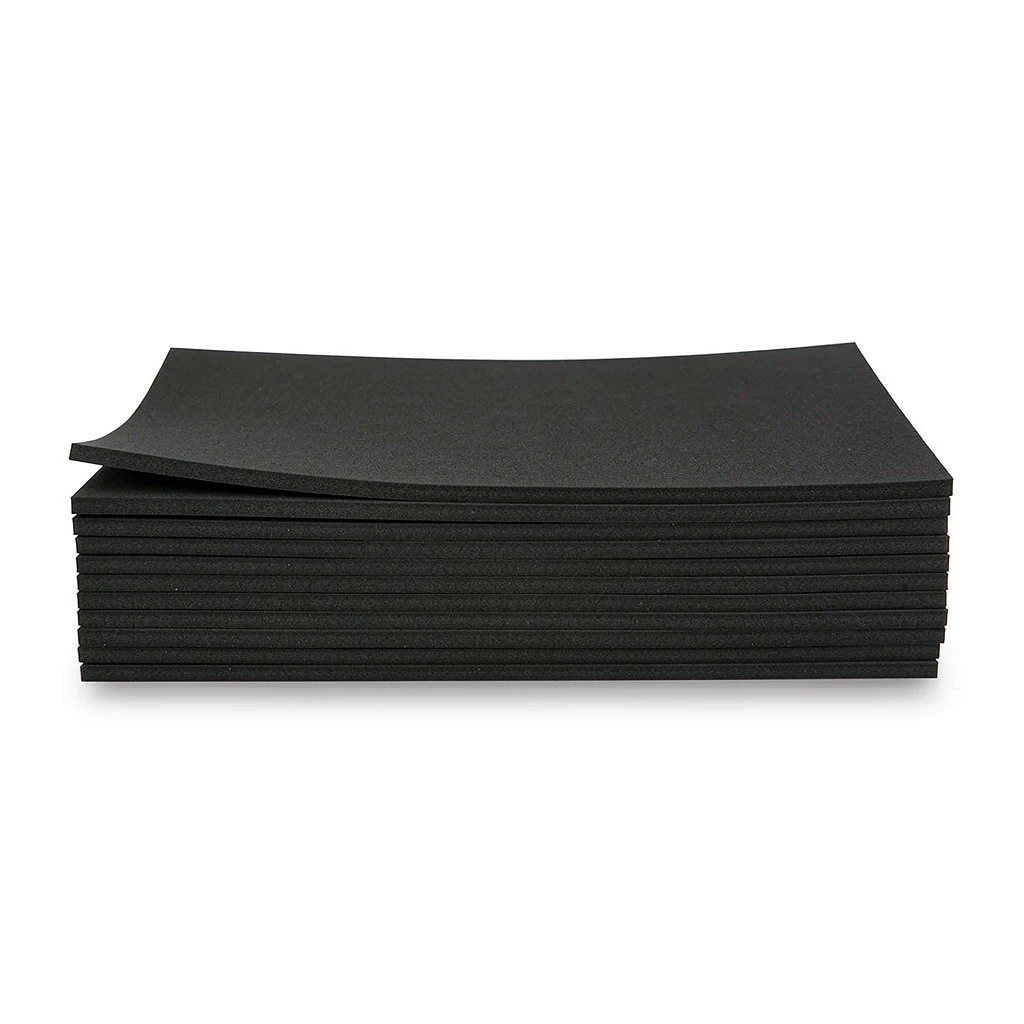
Colour is often the first custom variable. A smart move is to start from a stock format such as our black and white EVA foam roll and adjust the colour mix from there — it is faster and cheaper than colour-matching from a blank sheet.
Custom EVA work spans a wide range: die-cut gaskets and washers, CNC-routed inserts and trays, compression-moulded midsoles and pads, and laminated sheets with adhesive backing. The same four-step process applies whether you need 500 pieces or a full container, so it helps to understand the flow before you commit.
Step 1 — Inquiry and spec
Send us your drawing, sample, or even a photo with dimensions. Include the material spec, colour, quantity and target price. The more you pin down up front, the fewer rounds you burn. If you are unsure what density or hardness to ask for, our guide on how to specify EVA foam walks through the three numbers that matter.
The single most useful thing you can send is a reference sample or CAD file. A physical part lets us reverse-engineer the exact density, hardness and surface finish, while a CAD drawing gives us dimensional accuracy from day one. Photos alone work for a first ballpark quote, but they always lead to a clarification round on tolerances.
Step 2 — Sampling (5–10 days)
We make 3–10 physical samples so you can check feel, fit and colour in the hand. For moulded parts this may need a prototype tool; for routed parts we cut directly from sheet. Sampling fees are usually credited against your first mass order, so the sample round rarely costs you anything in the end.
Expect to iterate. The first sample rarely lands perfectly — a midsole may feel slightly too firm, or a cavity a fraction too snug. That is normal and is exactly what the sampling round is for. Budget one revision cycle into your timeline so a first-pass tweak does not surprise you.
Step 3 — Tooling and pilot run
On sample approval we build production tooling. A pilot run validates cycle time and quality before full release — this is the step that catches dimensional drift and cosmetic defects before they scale into thousands of parts.
Tooling is where the real investment sits. A simple steel-rule die for flat cut parts is inexpensive and fast, while a multi-cavity compression mould for a contoured midsole costs more but pays for itself quickly at volume. We will recommend the right tooling tier for your quantity so you are not over-paying for capability you do not need.
Step 4 — Mass production and QA
Standard lead time is 7–25 days depending on volume. Every batch ships with an inspection report, and third-party SGS testing is available on request. If compliance matters for your market, see what importers should ask in our REACH, RoHS and SGS checklist.
Through production we sample-check dimensional tolerance, density and hardness against the approved sample, so the parts that leave the line match the parts you signed off on. Consistency across a long run is where a 15-year factory earns its keep — the first box and the last box should be indistinguishable.
Why a 15-year EVA factory matters for custom work
Custom EVA is less about the foam itself and more about repeatability. Anyone can cut a sheet; the hard part is making part number 10,000 match part number 1, month after month, across colour batches and density grades. That consistency comes from controlled resin compounding, calibrated tooling and a QA process that checks against the approved sample on every run.
It also shows up in the details buyers rarely think to ask about: how the foam ages under load, whether the colour drifts between batches, how tight the thickness tolerance holds across a full sheet. A factory that has run EVA daily for 15 years has already solved problems you have not encountered yet — which is the whole point of choosing an OEM partner rather than a generic converter.
For a deeper read on the material itself, start with our guide to what EVA foam is and why buyers choose it.
What to prepare before you contact us
| Input | Why it matters |
|---|---|
| Target annual volume | Drives the tooling choice — a prototype tool vs production steel. |
| Compliance requirements | REACH, RoHS, children’s-product limits decide the formulation. |
| Packaging & labelling | Affects unit cost and how parts arrive. |
| Reference sample or CAD | The single fastest way to an accurate quote. |
| Target price point | Lets us engineer to cost — the right density and tooling tier, not the most expensive one. |
Custom EVA foam: frequently asked questions
How long does a custom EVA order take?
Sampling runs 5–10 days, tooling and pilot a further 1–2 weeks, and mass production 7–25 days depending on volume. A typical first order from inquiry to delivery is around 4–6 weeks.
Are sampling fees refundable?
Yes — sampling fees are usually credited against your first mass order, so the sample round effectively costs nothing once you proceed.
What is the minimum order quantity?
B2B orders typically start around $5K, but we keep barriers low for a first test: samples can ship before you commit to volume.
Can you match a custom colour?
Yes. Colour is matched in the resin via masterbatch, so it runs through the whole foam rather than sitting on the surface. Send a Pantone reference or a physical swatch.
Do you provide inspection reports?
Every batch ships with an inspection report, and third-party SGS testing is available on request for markets that require independent verification.
Custom starting points from our stock range
\n
Most OEM projects begin by modifying something already proven. The black EVA foam roll gives you thickness freedom from 1–20 mm in one continuous format, and the colour EVA foam sheets show how masterbatch colour reads on a finished part. Pick the closest existing spec, then tell us what to change.
Start your custom EVA project
Open an RFQ with your drawing or sample, and we will route you to the right team and come back with a timeline and a sample plan.