 AOWEIDA
How to Specify EVA Foam: The 3 Numbers That Matter
A wrong spec means a wrong sample. Before you email a supplier, lock down these three numbers — they decide roughly 90% of how the foam behaves. Get them right and your first sample usually lands; get them wrong and you burn a round-trip, a shipping fee and a week.
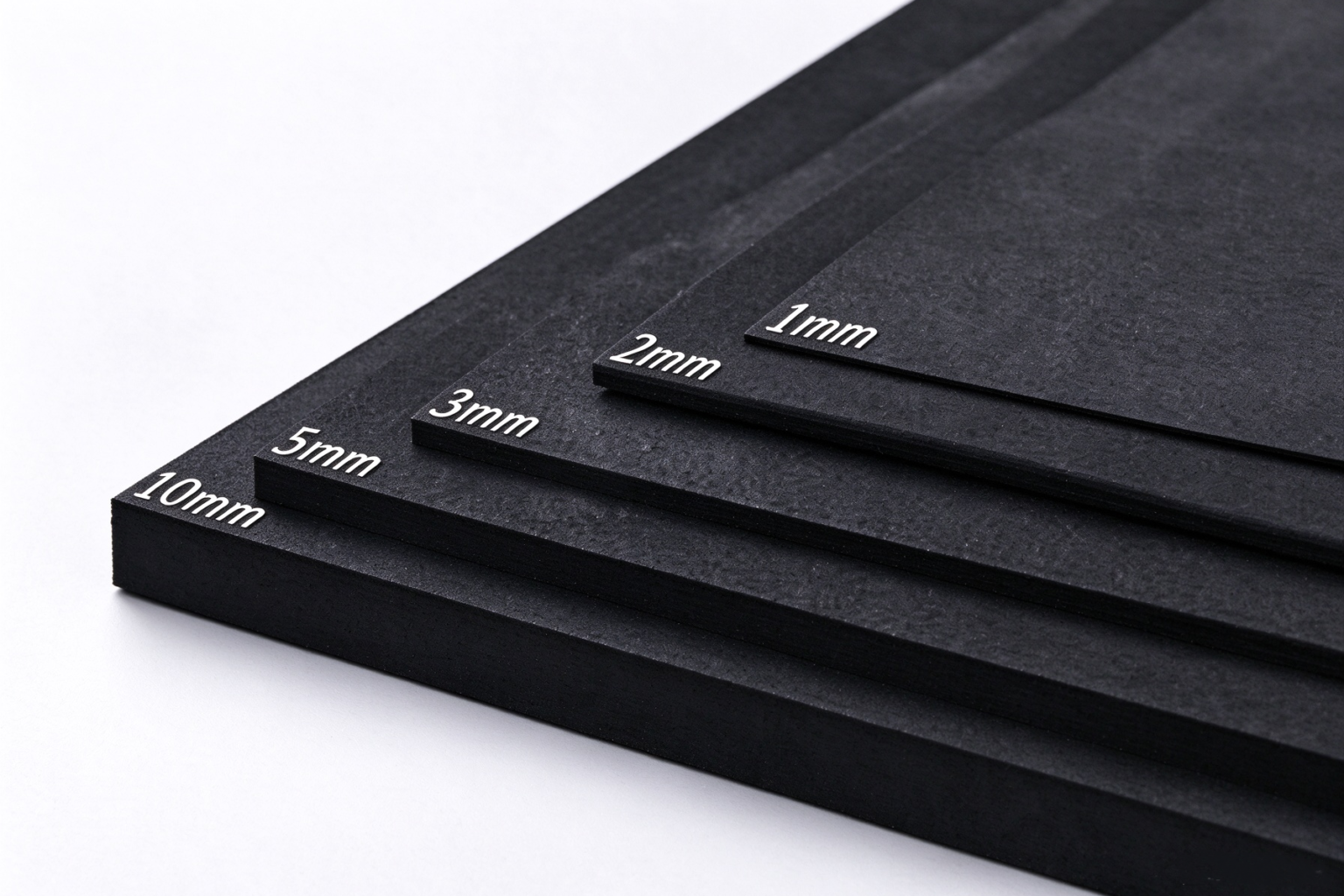
You can see all three applied in our Black EVA Foam Roll, which is produced at 86 kg/m³ across the full 1–20 mm range.
Spec 1: Density (kg/m³)
Density drives weight, firmness and cost per part — it is the single most important number on an EVA spec sheet. It is measured in kilograms per cubic metre, and it directly controls how much material goes into a given volume.
| Density range | Feel & weight | Typical applications |
|---|---|---|
| 30–45 kg/m³ | Ultra-light, very soft | Yoga mats, padding, costume foam |
| 60–100 kg/m³ | Mid-weight, firm, resilient | Footwear, general packaging |
| 120–200 kg/m³ | Heavy, structural, high load | Tool inserts, load-bearing pads |
As a rule of thumb: higher density means firmer, heavier and more expensive; lower density means softer, lighter and cheaper. The trick is matching density to the load the part will actually see, rather than defaulting to “as light as possible”.
Spec 2: Hardness (Shore C)
We rate EVA foam on the Shore C scale, not Shore A — the two scales are different and mixing them up is a common source of wrong samples. The practical range runs from about 15C (very soft) to 80C (firm).
| Hardness | Feel | Typical application |
|---|---|---|
| 35–45C | Soft, conforming | Yoga mats, comfort padding |
| 45–60C | Supportive, springy | Shoe midsoles |
| 60–75C | Firm, structural | Toolbox inserts, protective trays |
If your part gets compressed repeatedly — a midsole, a cushioning pad — specify hardness by the feel under load, not just the number. A sample that is right on paper can still feel wrong in the hand, so always state the application alongside the durometer reading.
Spec 3: Thickness and tolerance
Standard EVA sheet thickness runs 1–100 mm. The number you quote should match how the part is made, because tolerance is where suppliers quietly differ.
- ±0.2 mm — achievable on CNC-routed parts.
- ±0.5 mm — typical on moulded or compression-cut sheets.
If your foam is going into a precision cavity or a stack-up with other components, specify the tighter tolerance up front. If it is a mat or a liner where ±0.5 mm is invisible, do not over-specify — tight tolerance costs money you do not need to spend.
Bonus specs: VA content and colour
VA content (the percentage of vinyl acetate in the copolymer) affects clarity, flexibility and softness. Higher VA is softer and more elastic; lower VA is tougher and more rigid. Most commercial EVA foam sits between 5% and 40% VA.
Colour is effectively unlimited via masterbatch. Send a Pantone reference or a physical swatch, and the colour is matched in the resin before foaming — which means it is the same colour all the way through, not a surface coating that rubs off.
How to write an EVA RFQ that gets an accurate quote
Put these six fields in your request and you will get a price and a sample that actually match what you need:
- Density — kg/m³ (or a target weight range).
- Hardness — Shore C durometer (or “yoga-mat soft” / “midsole firm”).
- Thickness + tolerance — e.g. “10 mm ±0.5 mm”.
- Sheet or roll dimensions — width × length, or a roll length.
- Colour — Pantone code or swatch.
- Quantity + application — sample count and what the part does.
If you are moving from a first sample toward production, our walkthrough of OEM custom EVA from sample to mass production covers the timeline and what to expect at each stage.
How to specify EVA foam: frequently asked questions
What density of EVA foam should I choose?
Match density to load. 30–45 kg/m³ for lightweight padding and yoga mats, 60–100 kg/m³ for footwear and general packaging, and 120–200 kg/m³ for structural inserts. Our standard roll grade is 86 kg/m³, which covers most footwear and packaging work.
Is EVA hardness measured on Shore A or Shore C?
Shore C. EVA foam is too soft for Shore A to read meaningfully, so the industry uses Shore C. Always confirm which scale a supplier is quoting — mixing the two is a common cause of wrong samples.
What tolerance should I specify?
±0.2 mm on CNC-routed parts, ±0.5 mm on moulded or compression-cut sheets. Specify tight tolerance only where the part sits in a precision cavity; over-specifying adds cost with no functional benefit.
Can I get a custom colour?
Yes. Colour is matched in the resin via masterbatch, so it runs all the way through the foam rather than sitting on the surface. Send a Pantone reference or a physical swatch.
Do I need to specify VA content?
Usually no — for most applications density and hardness already define the feel. VA content matters when you need a specific flexibility or clarity, so mention it only if it is a real requirement.
Send a spec that gets a fast, accurate quote
Lock down your three numbers and send us your application — we will recommend a starting grade, density and thickness, and ship samples so you can verify before you commit.