 AOWEIDA
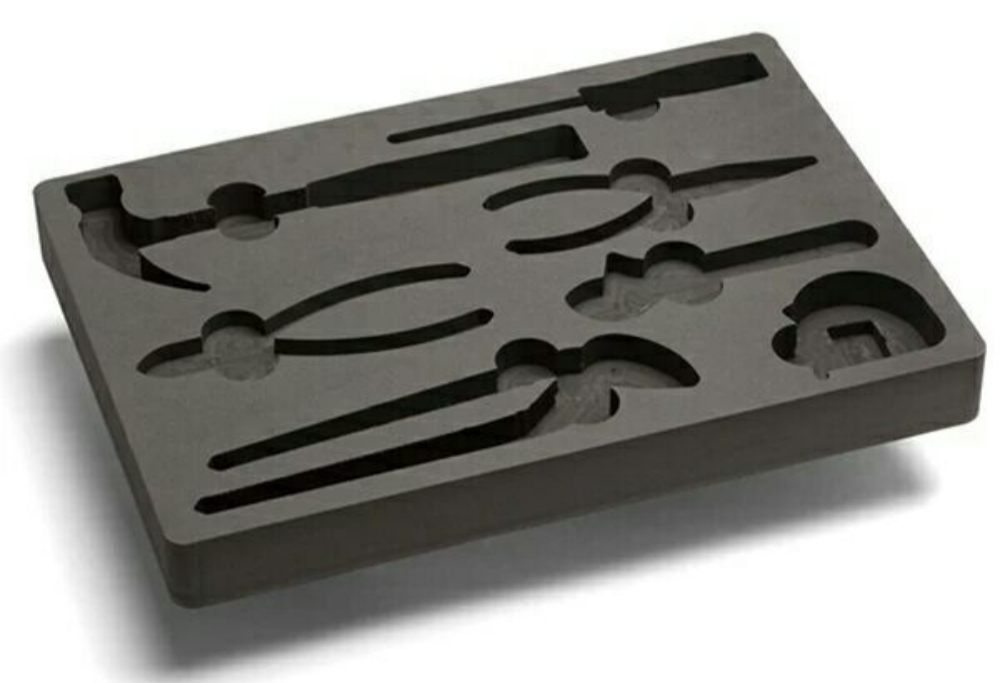
EVA Packaging Inserts That Protect Precision Goods
If your product is fragile, premium, or simply needs to “arrive perfect,” EVA inserts are the quiet hero of good unboxing. Unlike loose-fill or bubble wrap, a die-cut EVA insert holds each item in a fixed cavity, so nothing shifts, rubs or rattles during transit.
Most insert designs begin from sheet stock cut to case depth, and our EVA Foam Roll is the most commonly specified base material.
The difference between a generic foam insert and a well-engineered EVA tray is visible the moment the case opens. A good insert makes the product look considered, reduces returns from transit damage, and quietly reinforces the premium positioning of whatever is inside.
Why EVA, not cardboard or bubble wrap
- Form-fit — CNC routing carves exact cavities so items cannot shift.
- Reusable — holds shape across hundreds of open/close cycles, unlike cardboard that creases and tears.
- Premium feel — matte black or brushed EVA signals quality the moment the case opens.
- Clean and inert — closed-cell foam does not shed particles or react with the product, which matters for electronics and instruments.
- Moisture resistant — closed-cell structure resists water and oils, so tools and optics stay dry in transit and storage.
Cardboard and bubble wrap are fine for a one-way parcel, but they read as “shipping material.” An EVA insert reads as part of the product experience — the customer keeps the case, reuses the tray, and remembers the brand every time they open it.
Typical applications
| Application | What the insert does |
|---|---|
| Camera & drone cases | Cushions optics and gimbals against impact |
| Medical instrument kits | Holds sterile tools in fixed, clean cavities |
| Watch & jewellery boxes | Gives a premium unboxing and holds pieces still |
| Tool organisers | Shaped slots so each tool has a home |
| Trade-show loan units | Reusable protection across many handovers |
| Electronics & instruments | Inert, anti-static-compatible protection for delicate boards and optics |
For extra structure we laminate EVA to a rigid panel or a layer of EPE — the EVA gives the soft, premium contact surface while the backing holds the tray rigid.
How a custom insert is designed
The process is simpler than most buyers expect:
- Send a CAD file or a physical sample of the item.
- We scan and reverse-engineer the cavity to a precise pocket profile.
- We produce a proof tray for your sign-off before cutting the full run.
That proof step is the important one — it is where you catch a cavity that is a millimetre too tight or a finger notch that is awkward, before it scales into a production run. For the full custom workflow from spec to mass production, see our guide on OEM custom EVA from sample to mass production.
Why the right insert lowers your total cost
It is tempting to see a custom EVA insert as a cost, but for precision goods it is usually a saving in disguise. Transit damage, returns and repacking are the expensive lines on a product’s P&L — an insert that prevents them pays for itself quickly, especially on premium items where a single damaged return wipes out the margin on several sales.
There is a marketing dividend too. When a customer opens a case and finds their purchase sitting in a clean, form-fit tray, it raises the perceived value of the product itself. That is why so many brands use a custom EVA insert as much for the unboxing moment as for the physical protection. If you are importing at volume, see our guide to importing EVA foam in bulk for how inserts fit into a container order.
Getting the cavity right: three design tips
- Leave a small clearance — a cavity cut to the exact part size will be too tight; add a fraction of a millimetre so items drop in and lift out cleanly.
- Add a finger notch — a small cutout beside each cavity makes removal far easier and feels more considered.
- Match density to weight — heavier items need higher-density EVA so the tray does not compress and lose its grip over time.
One more tip worth flagging early: think about how the user removes the item at the design stage, not after. A tray that protects perfectly but frustrates removal gets abandoned. A 2 mm clearance and a well-placed notch turn a good insert into a great one.
EVA packaging inserts: frequently asked questions
What is an EVA foam insert?
A die-cut or CNC-routed tray made from closed-cell EVA foam, cut with cavities that match a specific product so it stays fixed and protected inside a case or box.
Is EVA better than foam for packaging?
For precision protection and a premium feel, yes — EVA holds a clean cavity, resists moisture, and returns to shape over hundreds of cycles, where cheaper open-cell foam compresses and wears.
Can I get a sample insert before ordering?
Yes. Send a CAD file or physical sample and we will produce a proof tray for your sign-off before cutting the full run.
What thickness of EVA should I use for an insert?
Match it to case depth and part weight. Most insert trays run 5–20 mm, with higher-density foam for heavier items. Our stock rolls cover 1–20 mm.
Can EVA inserts be custom coloured?
Yes. Black is the default for a premium look, but colour is matched in the resin — any Pantone or swatch can be produced.
Material options for your tray
\n
Most insert work starts from a sheet or roll we already make. The black and white EVA foam sheets suit flat protective layers, while the black EVA foam roll gives you 1–20 mm thickness for deeper tray walls. Both are die-cut to your drawing.
Design a tray that protects your product
See our packaging range or talk to us about a custom tray — send a drawing or sample and we will return a proof and a quote.